Arena: Market Conditions Before Doximity
U.S. physicians · 2010 · United States
Scattered supplyRegulatory constraintsDisconnected workflows
A U.S. doctor's professional identity was scattered across hospital directories, specialty societies and license records, and none of them let a physician find and message a colleague at another hospital. Clinical communication still ran on pagers, phone calls and fax, and patient-privacy rules constrained ordinary texting and email. General networks such as Facebook and LinkedIn did not check who was a doctor DXX-7. Drug makers and hospital recruiters wanted to reach physicians by specialty and location, but relied mainly on in-person sales representatives and offline marketing DXX-2 DX2.
How each step happened
Step 1 of 5 · 2010–11
Verified real-name profiles, pre-built from records
Doximity's founding choice was a network only for U.S. medical professionals, under their real names. Jeff Tangney had co-founded Epocrates, the drug-reference app that brought mobile software into clinical practice, and the founders had lived what they called the paper and fax chase of hospital work DXX-4 DXX-1.
Verification made the profile worth something. A member confirms identity with a National Provider Identifier (NPI), a Drug Enforcement Administration (DEA) registration number or a medical email, and most find a profile already filled in from public and commercial data and updated daily DXX-2. Because every profile carries a checked specialty, credential and location, a colleague can trust it, and a paying customer can later define an audience with it DXX-2 DX2. The Series A investor described it as 'LinkedIn and Yammer for doctors' with messaging that met HIPAA, the U.S. patient-privacy law DXX-4.
Rivals Sermo checked licenses but let members post under handles, and a 2007 flaw let non-doctors register SR6; by 2016 about 90% posted anonymously, so its network held no professional identity a colleague or customer could use SR16 SR48. LinkedIn offered broad identity without medical verification DXX-7 DX2.
Vertical Specialization
Step 2 of 5 · 2011–20
Free daily tools: messaging, fax, Dialer
The profile gave doctors a reason to join; free tools gave them a reason to return. Doximity began with HIPAA-compliant messaging, then added digital fax, a newsfeed and, in 2016, Dialer, which lets a clinician call a patient from a personal phone while the patient sees the office number DXX-4 DXX-6 DX2. Each tool replaced a chore doctors already did every day, such as chasing a fax or calling a patient without exposing a personal number. By early 2014 about 25% of members regularly used secure messaging, including the free eFax, and members sent more than 20,000 messages to each other a day SRX6 SRX15. Members pay nothing apart from a small paid tier, Dialer Pro DXX-2.
At the onset of COVID-19, Dialer added video, and more than 300,000 providers used Doximity's telehealth tools in the quarter to March 2021 DXX-2. Each tool that stuck raised engagement, engagement widened the audience commercial customers paid to reach, and that revenue paid for the next free tool DX2. The loop still runs: 0.81 million providers used the workflow tools in the quarter to March 2026, up from 0.58 million two years earlier DXX-3.
Rivals Sermo was a discussion forum for hard cases; by its own count its 550,000 members wrote 626,000 comments in the year to April 2016, about one each SR48. Zoom, Microsoft Teams and Teladoc offer single tools but not one app tied to a verified profile DX2.
Product-Led SalesGrowth Loop
Step 3 of 5 · 2012–21
Colleague network tipping by hospital, city, specialty
Verified names made each new member useful to the ones already there. Members search for colleagues and specialists by name, specialty and location and connect with them to arrange referrals and coordinate care DXX-2 DX2. Tangney said in 2014 that tipping points came by sub-market, 'a hospital, a city, or a specialty', once doctors in an existing group felt left out if they were not on it; the more doctors Doximity had in a hospital, the more each of them used it SRX6. Growth came mostly by word of mouth DXX-2: about 10% of U.S. physicians joined within two years, 40% by early 2014 and 70% by February 2017, along with 90% of fourth-year medical students DXX-7 DXX-6.
By March 2021 members had made more than 56 million connections, an average of over 50 colleagues per physician DXX-2. In the company's filings, more useful tools bring more members, which makes the network more valuable to them and to customers who want specific groups of physicians DX2.
Rivals Sermo's U.S. membership levelled off near 130,000 by 2012, growing about 4% a year SR20. Doximity passed it with 250,000 physicians by early 2014, while anonymous handles gave Sermo members no directory in which to find a named colleague SRX5 SR23.
Collaboration & exchange network effects
Step 4 of 5 · 2014–21
Doctors free; hospitals and pharma pay for targeted reach
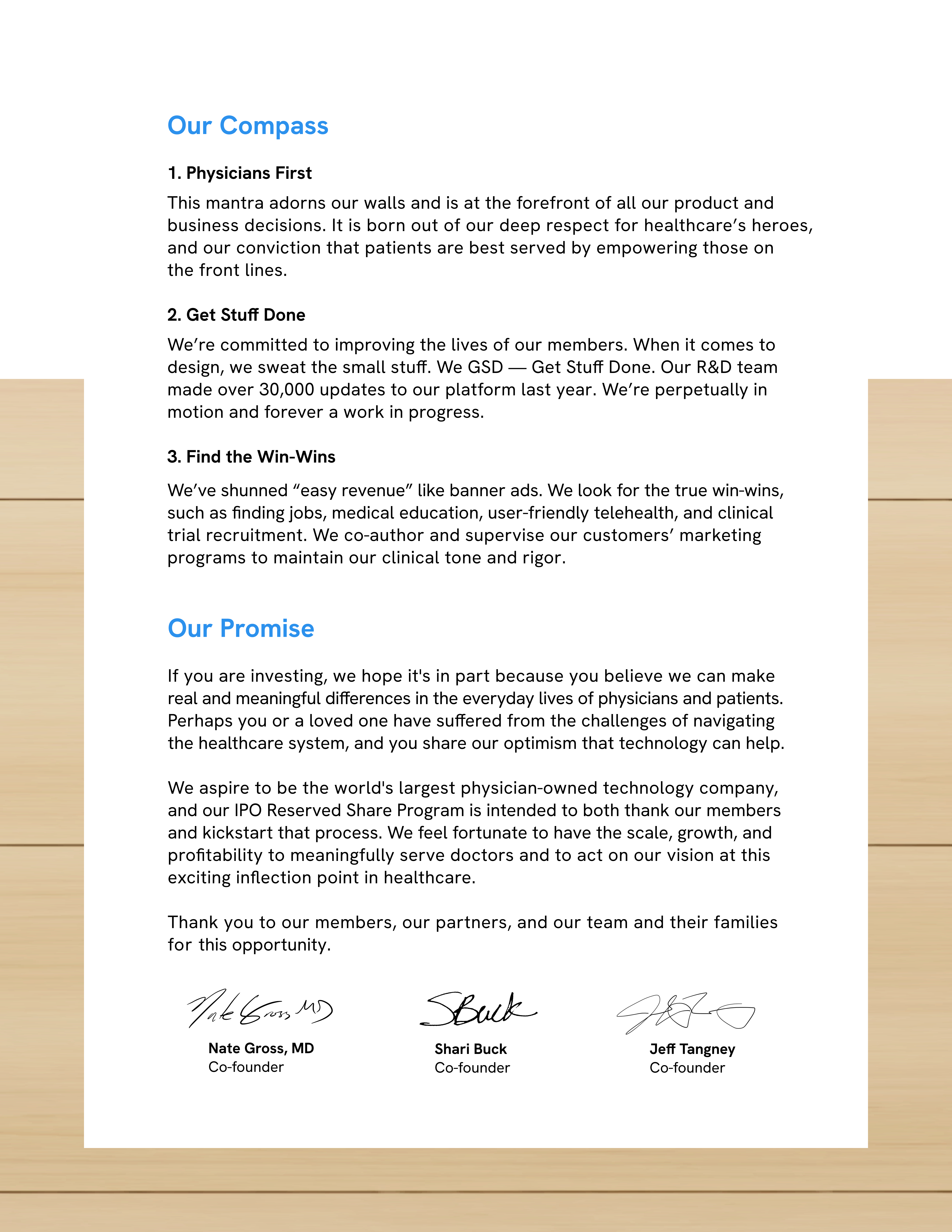
Doximity kept doctors free and charged the organizations that wanted to reach them. The founders turned down what they called the easy revenue of banner ads and sold jobs, medical education, telehealth and clinical-trial recruitment instead, co-writing and supervising customers' marketing so it kept a clinical tone DXX-1. Recruiting grew first: by early 2014 more than 200 hospitals and health systems were recruiting clients, and Doximity had its first cash-flow-positive month that January SRX6. Today Hiring Solutions lets health systems and recruiting firms reach candidates, including doctors not looking for a job; Marketing Solutions lets a drug maker choose an audience by specialty, credential and location and send it sponsored news, videos and peer content DX2. Both sell the verified profile from step 1.
Accounts grew one purchase at a time. Drug makers buy programs brand by brand and health systems by clinical service line, such as cardiology or oncology, so an account expands as more brands and service lines sign on DX2. By March 2021 all of the top 20 pharmaceutical manufacturers and all 20 hospitals on the U.S. News Honor Roll were customers, and net revenue retention, this year's subscription revenue from last year's customers as a share of last year's, was 153% DXX-2. The model was profitable at scale: $475.4 million of revenue and $147.6 million of net income in the fiscal year to March 2024 DX2.
Rivals Sermo sold anonymized doctor talk to Wall Street firms and then to drug makers, shifted to pharma when financial-services budgets fell in 2009, and was sold to the survey firm WorldOne in 2012 SR3 SR13 SR18. Doximity competes for the same budgets with WebMD's Medscape and offline medical marketing DX2.
Cross-SubsidyLand and Expand
Step 5 of 5 · 2021–
Catch-up barrier: verified reach to most physicians
What a rival cannot buy quickly is the profile base itself. Members include more than 85% of U.S. physicians and about 90% of graduating medical students, counted when they claim a pre-filled profile or create one DXX-3. Doximity says the data set built from a decade of member activity and public records would be 'highly challenging and time consuming for any competitor to replicate' DXX-2. Customers pay for that coverage: 125 customers spent at least $500,000 each in fiscal 2026 and gave about 83% of revenue DXX-3. A better-funded rival could copy the tools. It could not quickly assemble current, verified profiles of most American doctors, which took the pre-filled records of step 1 and years of daily use from step 2.
The barrier protects the audience, not every route to doctors' attention. OpenEvidence, a free AI answer tool paid for by pharmaceutical advertising, reached 40% of U.S. physicians by July 2025, and Doximity's 10-K now names it as a competitor for marketing budgets DXX-10 DXX-3. Net revenue retention fell from 119% to 109% in fiscal 2026, and in May 2026 Doximity forecast 3–5% growth for the next year; analysts said budget managers were turning to cheaper AI tools, and the stock fell 24% DXX-3 DXX-9. The profiles still cover most physicians; the test now is whether doctors keep spending their attention where the profiles are.
Rivals Sermo rebuilt itself as a paid survey panel, running about 700,000 surveys a year by 2016, and does not appear among the competitors in Doximity's filings, which name WebMD's Medscape and OpenEvidence SR22 SR48 SRX14 DXX-3. QuantiaMD, another physician network funded by drug makers, was sold in 2015 with a $2.9 million impairment DXX-11.
Accumulated assets & catch-up barriers